How Much Do Lagosians Spend on Transport Per Month? (2026 Breakdown)
What does it actually cost to live in Lagos without a car in 2026? We did the maths across three income levels and the numbers will make you rethink everything.
Tomisin Osibote
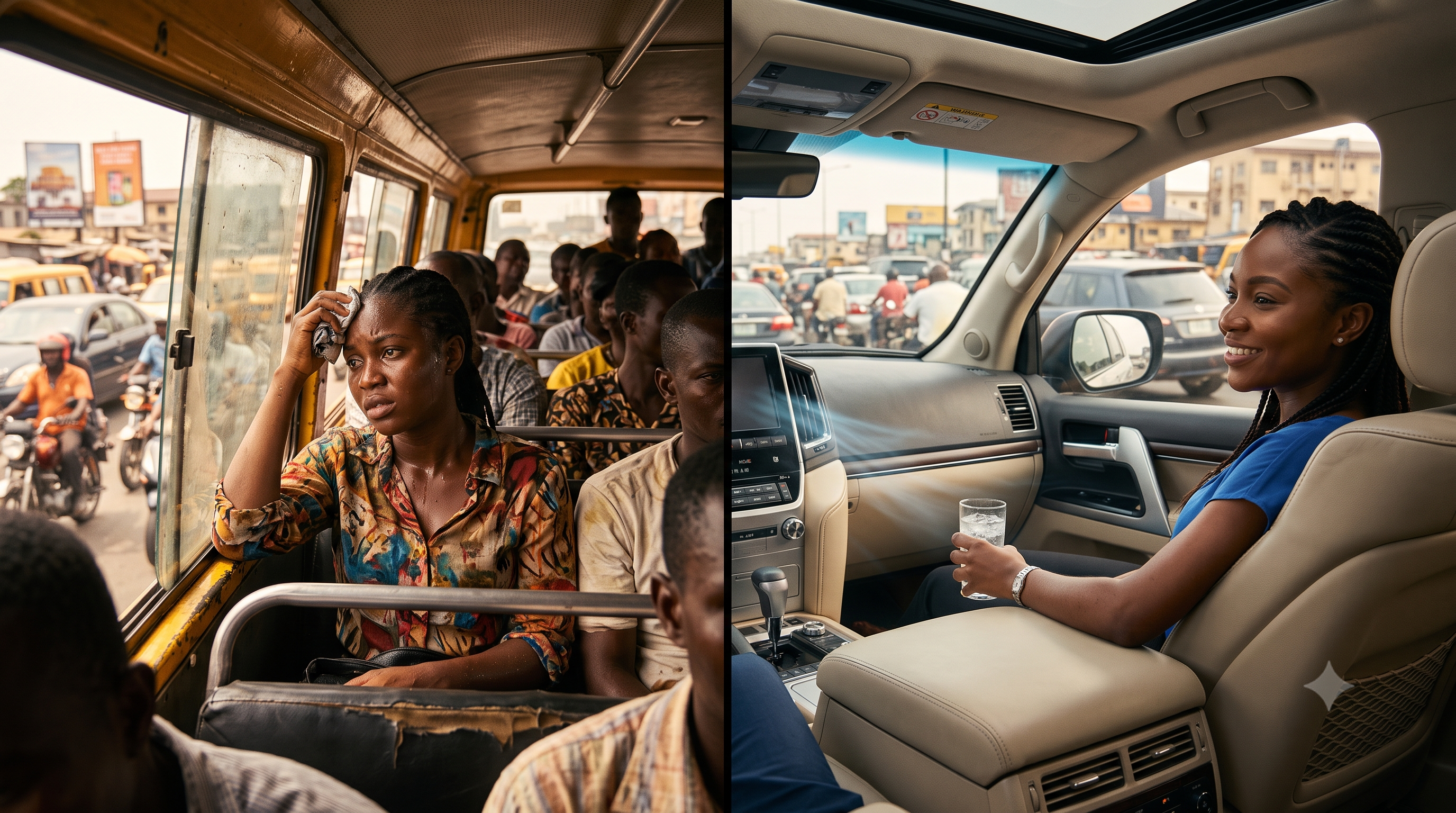
Nobody sits down at the start of the year and adds up what they spend getting around Lagos.
They should.
Because the number is almost always shocking, and for many Lagosians, it is the single largest expense in their monthly budget after rent. Bigger than food. Bigger than school fees. Bigger than electricity. Transport is quietly eating a significant portion of what Lagos workers earn every month, and most people have no idea how much until they actually do the maths.
We did it for you. Here is what not having a car in Lagos is actually costing you in 2026.
First, Let's Establish the Baseline
The average Lagosian spends 40% of their income getting to work. That is not a misprint, it is the finding from the London School of Economics and the International Growth Centre, and it has not improved.
Transportation costs can consume 20 to 50% of the average Nigerian's monthly budget, especially in cities like Lagos. But for workers commuting from the outskirts of the city to the island or central business districts, the real figure is far higher.
Here is what the numbers look like across three real Lagos commuter profiles.
Profile 1 — The Public Transport Commuter
Lives in Alimosho or Ikorodu. Works on the mainland. Uses Danfo, BRT, and Keke daily.
Danfo buses in Lagos range from ₦400 to ₦1200, while BRT buses range from ₦680 to ₦1,710 for longer routes like Berger to Ajah. Keke Napep fares range from ₦200 for very short distances to ₦800 or more for longer routes.
A typical daily commute for this profile looks like this:
Journey | Cost (One Way) |
Keke from home to bus stop | ₦300 |
Danfo to connecting stop | ₦500 |
BRT to work area | ₦700 |
Total one way | ₦1,500 |
Daily round trip | ₦3,000 |
Working 22 days a month, that is ₦66,000 per month on commuting alone. Add weekend trips, errands, church, and social events, and the monthly figure easily crosses ₦80,000 to ₦100,000.
Annually: ₦960,000 to ₦1,200,000.
On a salary of ₦150,000 to ₦200,000 per month, this commuter is spending between 30% and 60% of their income just getting around.
Profile 2 — The Mixed Commuter
Lives in Yaba, Surulere, or Gbagada. Works on the Island. Mixes BRT with Bolt and Uber.
This is the most common Lagos professional profile. Too far to walk, too expensive to Bolt every day, so they navigate a daily calculation of which combination of transport to use.
Even the BRT-and-Danfo combination runs ₦82,000 monthly for a Yaba-to-VI commute.
On days when they use Bolt instead:
A typical mainland-to-island trip on Uber runs ₦10,00 to ₦16,000, often higher due to bridge traffic surge. Bolt comes in slightly cheaper at ₦8,000 to ₦12,000 on the same route.
A mixed month: 11 days on public transport, 11 days on Bolt, looks like this:
Transport | Days | Daily Cost | Monthly Total |
BRT + Keke combo | 11 days | ₦2,000 round trip | ₦44,000 |
Bolt round trip | 11 days | ₦20,000 round trip | ₦220,000 |
Weekend/personal trips | 8 days | ₦5,000 average | ₦40,000 |
Total | ₦304,000 |
Annually: ₦3,648,000.
That is almost ₦4,000,000 a year. On transport.
Profile 3 — The Ride-Hailing Professional
Lives in Lekki or Ajah. Works in Victoria Island. Uses Bolt or Uber daily.
This is the profile nobody talks about honestly. Lagos professionals who believe they have "made it" because they no longer take public transport but are quietly spending more on monthly transport than some people earn.
A professional earning ₦800,000 per month who takes Bolt to Victoria Island twice daily is spending ₦420,000, about 55% of their salary — on transport alone.
Bolt-only commutes from Ajah, Alimosho, or Ikorodu to the Island can exceed ₦400,000 per month, almost a full premium-school fee per year.
Let us be conservative and model a Lekki Phase 1 to VI professional:
Journey | Daily Cost |
Morning Bolt to work | ₦8,000 |
Evening Bolt home | ₦12,000 (surge) |
Lunch and errands | ₦5,000 |
Daily total | ₦25,000 |
22 working days: ₦550,000 per month. Weekends and personal trips: ₦60,000 per month. Monthly total: ₦600,000.
Annually: ₦7,200,000.
Seven million naira. On transport. Every year.
The Numbers Side by Side
Profile | Monthly Transport Spend | Annual Transport Spend |
Public transport commuter | ₦80,000 – ₦100,000 | ₦960,000 – ₦1,200,000 |
Mixed commuter (BRT + Bolt) | ₦200,000 – ₦300,000 | ₦2,400,000 – ₦3,600,000 |
Ride-hailing professional | ₦400,000 – ₦600,000 | ₦4,800,000 – ₦7,200,000 |
The Bottom Line
Lagos does not make it easy to get around without a car. The financial cost is real, it is large, and it is growing every year as fuel prices and ride-hailing fares continue to rise.
The first step to managing it is knowing exactly what you are spending. Most Lagosians are shocked when they do this calculation for the first time. If this piece prompted you to open your bank app and add up your last three months of transport spending — good. The number you find is the number you are working with. Now you can start making smarter decisions about it.
FAQs
How much does the average Lagosian spend on transport per month? It varies significantly by commute distance and transport mode. Public transport commuters typically spend ₦80,000 to ₦100,000 monthly. Mixed commuters who combine buses with occasional Bolt or Uber spend ₦200,000 to ₦300,000. Professionals relying entirely on ride-hailing can spend ₦400,000 to ₦600,000 or more monthly, particularly on mainland-to-island routes.
Is Bolt or Uber cheaper in Lagos in 2026? Bolt is generally cheaper in roughly 60 to 70% of scenarios, particularly during peak hours or when navigating long distances such as from the Mainland to the Island. Bolt typically saves riders between 5% and 15% on standard commutes. However, Uber can be cheaper on short, off-peak trips due to its lower base fare on the UberGo tier.
What is the cheapest way to commute in Lagos? The BRT remains Lagos's best-kept financial secret. At ₦680 to ₦800 per trip on dedicated lanes that bypass the worst traffic, it is 10 to 20 times cheaper than ride-hailing. For mainland corridors specifically, BRT combined with Keke for the first and last mile is consistently the most cost-effective commute option.
Does surge pricing significantly affect monthly transport costs in Lagos? Yes, materially. Apps like Uber and Bolt use automated multipliers that can raise fares 30 to 80% during peak demand, rain, or low driver availability. For a professional taking Bolt daily, even moderate surge pricing can add ₦50,000 to ₦100,000 to the monthly bill.
Is renting a car monthly in Lagos cheaper than daily ride-hailing? For professionals spending ₦300,000 or more per month on ride-hailing, a monthly dedicated vehicle arrangement can be comparable or cheaper with the added advantages of a fixed, predictable cost, no surge pricing, and a professional driver who knows your schedule. Monthly arrangements through Muvment by Autogirl start from ₦1,200,000 for an executive sedan including driver, significantly less per day than the ride-hailing equivalent for heavy users.
Comments (0)
Be the first to make a comment
Comments are reviewed before they appear.